When we began this participatory grantmaking evaluation, we knew one thing clearly: this could not be a traditional report.
If we were asking real questions about shared power, relational accountability, and community-defined success, then the process, and the people shaping it, had to reflect those same values. This report needed to feel like the communities who shaped it. It needed to hold story and structure. Data and dignity. Rigor and love.
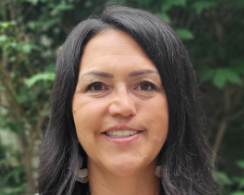
Today, we want to extend deep gratitude to three extraordinary partners who helped bring Community Love, Power, and Wisdom to life: evaluator Dr. Kimberlin D. Butler, designer Nicholas C. Turton and artist Alexandria Jimenez.
Holding Rigor and Possibility Together: Dr. Kimberlin D. Butler
 Our deepest gratitude goes to Dr. Kimberlin D. Butler, founder and Chief Possibility Catalyst of The L.E.A.D. Agency, who served as our participatory grantmaking evaluator and learning partner.
Dr. Kimberlin D. Butler is a globally and nationally recognized social impact leader with over 20 years of experience spanning education, philanthropy, and public affairs. She is a Certified Impact Philanthropy Advisor (IPA) and the Founder & Chief Possibility Catalyst of The L.E.A.D. Agency, partnering with foundations and social sector organizations to translate learning into strategy, grantmaking, governance, and convenings—alongside youth and systems-change partners. Her work bridges philanthropic learning, strategy, and practice to advance shared-power approaches that catalyze possibilities into action.
Dr. Butler’s practice focuses on reimagining philanthropy so that lived-experience leaders—especially youth—are positioned as partners in strategy, governance, and systems change. A former middle school teacher, she began her career in a family foundation, shaping investments across human services, health, and the arts while building convenings that supported grantee learning and capacity; she has also served as a trustee on multiple foundation boards. Dr. Butler’s leadership extends to roles with nationally recognized organizations, including Grantmakers for Education, where she led three national funder networks and partnered with nearly 600 foundations to improve educational outcomes and create pathways to economic mobility. Her public service includes work in the Obama Administration, where she advised the U.S. Secretary of Education on philanthropic alignment, advanced place-based initiatives, and planned White House convenings that brought funders together to address urgent challenges—grounded in urban, rural, and Native communities.
She is also the architect of Youth-Possible Philanthropy™, a framework that positions youth and lived-experience leaders as co-architects of strategy and governance—not simply as advisors or the people philanthropy is intended to serve. That lens shaped this evaluation in profound ways. Introduced to the field through her peer-reviewed article in The Foundation Review (2025), “Engaging Youth in Philanthropic Practice: Field-Building Strategies and the Promise of Youth-Possible Philanthropy™,” her work has been highlighted by Grantmakers for Effective Organizations in a Perspectives piece featuring YouthPossible Philanthropy™ in practice at the Peter & Elizabeth Tower Foundation. She is also leading the development of the YPP™ Practice Network—a global experiential learning community designed to support funders and youth as intergenerational partners in strengthening shared-power practice and systems change over time.
Dr. Butler earned her doctorate in educational and organizational leadership from the University of Pennsylvania, holds a Master of Public Administration in social policy from the Maxwell School of Syracuse University, and a Bachelor of Arts in mass communication from Louisiana State University.
From the outset, Dr. Butler insisted that this evaluation be more than assessment—it had to be partnership alongside community. Dr. Butler helped us name what we are building: a love-centered, shared-power approach to philanthropy that requires humility, courage, and structural commitment. She held us accountable to rigor while also protecting space for story, healing, and possibility.
Kimberlin, thank you for walking with us in authenticity, depth, and care—and for helping us gain a vantage point of not only our own participatory grantmaking but what it looks like across the field.
Translating Complexity into Clarity: Nicholas C. Turton
 Nicholas C. Turton, founder of Clay Creative, a human-centered design and strategic communications studio working at the intersection of storytelling and systems change. Based in Los Angeles—with roots in Buffalo, New York and Anchorage, Alaska—his work centers community-informed insight and impact-driven narrative as levers of change. Nicholas has partnered with organizations including Stop AAPI Hate, The Trevor Project, and AAPI Data, as well as foundations such as the California Community Foundation and The Lewis Prize for Music. Through Clay Creative, he helps mission-aligned institutions translate complex ideas into clear, resonant communications that advance equity and shared power.
Nicholas works at the intersection of storytelling and systems change. His studio partners with mission-driven organizations and foundations to translate complex ideas into clear, resonant narratives that advance equity and shared power.
From the very beginning, Nicholas understood that this report was not simply about presenting findings. It was about honoring lived and living experience. It was about designing something that could carry nuance without losing accessibility. Something that felt grounded and expansive at the same time.
His thoughtful layouts, visual pacing, and intentional communication design helped us ensure that this was not just a document—but an invitation. An invitation to reflect. To learn. To imagine philanthropy differently.
Nicholas, thank you for helping us translate complexity into clarity, and values into visible form.
Grounded in Land and Community: Alexandria Jimenez

The heart of this report lives in its artwork—and that heart was shaped by Alexandria Jimenez.
Alexandria Jimenez, is an artist, entrepreneur, mother, maker, and lifelong resident of Colorado among other things. She received her Bachelor of Fine Arts from Metropolitan State University Denver, where she studied in the Communication Design program. Professionally her background is at the intersection of education, philanthropy, community building, while collaborating with youth, artists and community in Denver and beyond.
She brings both technical craft and deep relational presence to everything she creates. In her own words, the common thread of this project was community and love.
“I had the privilege to collaborate with designer, Nicholas Turton and evaluator, Kimberlin Butler of The L.E.A.D. Agency on behalf of the AJL Foundation to interpret aspects of the report with graphics and illustrations. The common thread while creating the cover, center spread and appendix was community and love while leaning on the flora and fauna of the regions to bridge the connection between the Denver Metro and San Luis Valley. Many of the floral elements are from the gardens of my community grounding the connections to this land. The softness of the textures and color lend to the love and care that comes from shared responsibility as detailed in this report. There is also a nod in the appendix graphics to the historical beauty and movements that shaped our cultures and spaces both here in Denver and San Luis Valley. The curves and watercolor treatments are meant to evoke water, the life blood of our natural environments. Overall I hope these visual interpretations complement the strength and beauty of the people behind it and the power of collective voice.” - Alexandria
There are subtle nods in the appendix graphics to the historical beauty and movements that shaped Denver and the San Luis Valley. These details matter. They remind us that grantmaking does not happen in abstraction. It happens in place. In history. In culture.
Alexandria, thank you for creating visuals that honor the strength and beauty of the people behind this work—and the power of collective voice.
A Collective Creation
This report is not the product of one voice. This report exists because professionals across fields—evaluation, governance, strategy, communications, art, philanthropy—chose to work collaboratively rather than in silos. It exists because creative practice and technical practice were treated as equal partners. Because data and design were allowed to inform one another. Because community voice was not an appendix to the work, but its center.
Together, we created something none of us could have produced alone.